Squeezing a 550B Model onto a Single Node: Our Nemotron-3-Ultra Journey on 8× H200
Author: Shivank Chaudhary
Published: June 10, 2026
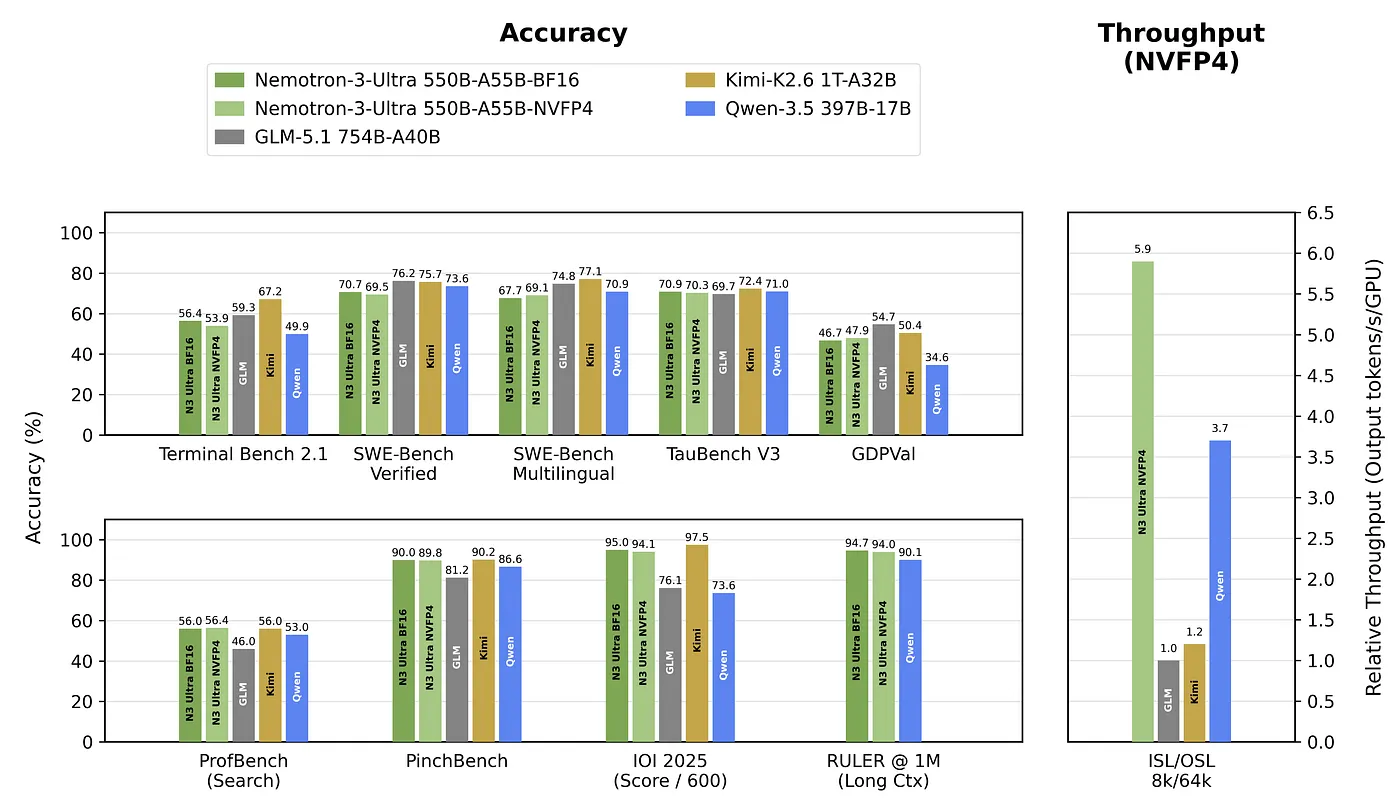
We wanted to serve NVIDIA Nemotron-3-Ultra-550B-A55B in production. It’s a beast:
550B total parameters / 55B active — a Mixture-of-Experts model
A hybrid Mamba-2 + Attention + MoE architecture with Multi-Token Prediction (MTP) speculative decoding
A native 256K context window
Our hardware was a single GPU node: 8× NVIDIA H200, ~140 GiB each, for ~1,123 GiB of total HBM.
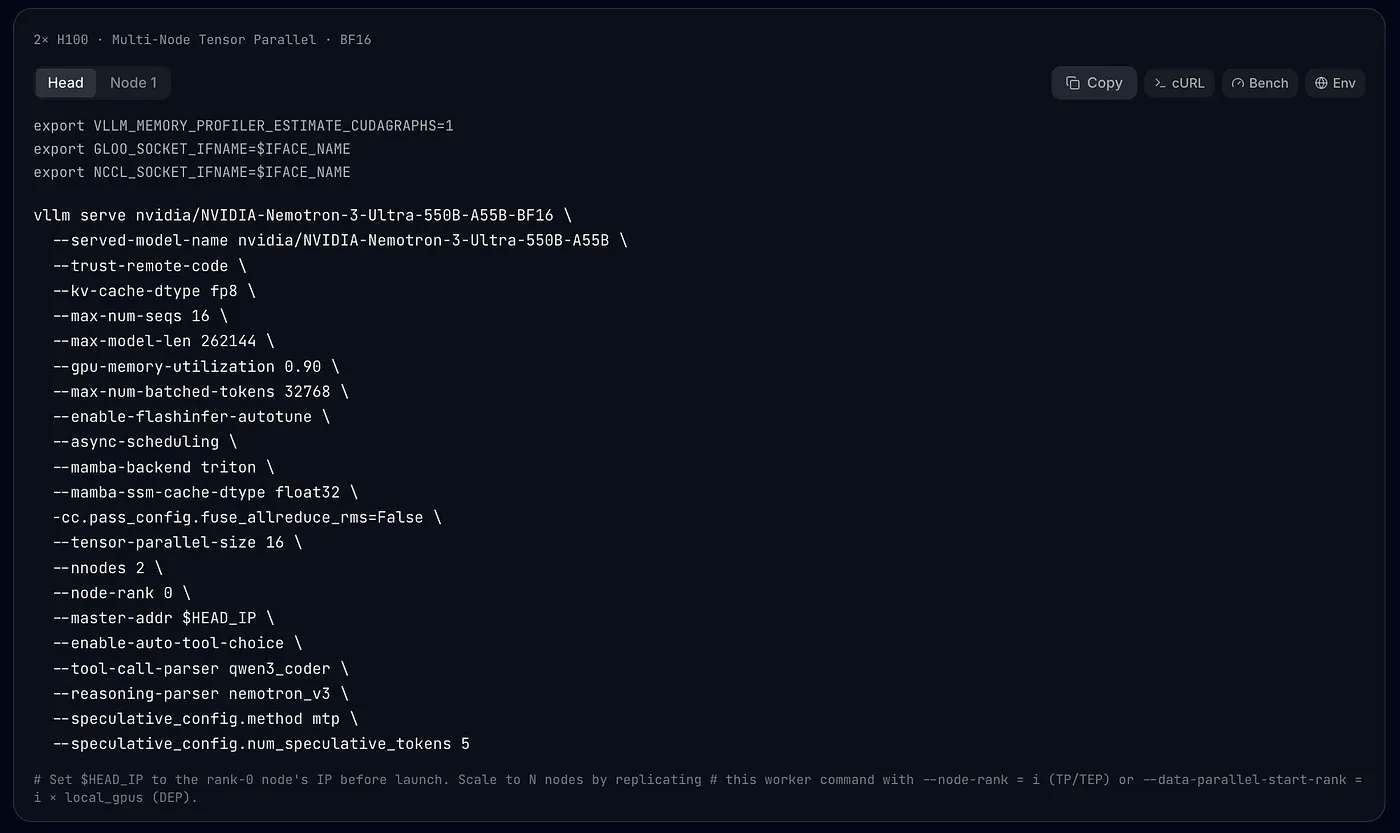
The official recipe for the BF16 checkpoint uses tensor-parallel-size 16 across 2 nodes — because BF16 weights alone are ~1.1 TB (550B × 2 bytes), which leaves no room for caches and activations on one node. We didn’t have a second node. So: can we make this fit on one 8-GPU box?
Ref: recipes.vllm.ai — NVIDIA-Nemotron-3-Ultra-550B-A55B-BF16
Before the memory fight, it helps to understand what this model actually is — because its architecture is exactly why the memory story plays out the way it does.
A quick primer: Transformers, Mamba, and MoE
If you’ve only ever heard “it’s a transformer,” this model has two more tricks worth knowing.
Transformers and the KV cache problem
A Transformer processes a sequence using self-attention: every token looks at every other token. That’s what makes them so good at recall and in-context reasoning — but it has a cost. Attention is quadratic in sequence length, and at inference time the model caches the keys/values of every past token (the “KV cache”) so it doesn’t recompute them. The longer your context, the bigger that KV cache grows — and at a 256K context window, that’s a lot of memory.
Mamba: constant-size state instead of a growing cache
Mamba is a State Space Model (SSM). Instead of attending to all past tokens, it carries a fixed-size recurrent state that it updates token by token — closer to how an RNN works, but designed to be parallelizable and hardware-efficient. The payoff:
Linear scaling with sequence length (not quadratic)
A constant-size state per sequence, no matter how long the context — no ever-growing KV cache
The downside: a pure SSM can be weaker at precise long-range recall (the thing attention is great at).
The hybrid: best of both
Nemotron-3-Ultra is a hybrid (the “Nemotron-H” lineage): it’s mostly Mamba-2 layers with a few attention layers sprinkled in. You get Mamba’s cheap, long-context efficiency for the bulk of the network, plus attention’s sharp recall where it matters most. This is why the model has both a “Mamba cache” (the SSM state) and a small KV cache (for the attention layers) — and why both show up as memory knobs later.
MoE: 550B of knowledge, 55B of compute
Finally, the Mixture-of-Experts (MoE) part. Instead of one giant dense feed-forward block per layer, an MoE layer has many smaller “expert” blocks and a router that sends each token to just a few of them. That’s the “550B total / 55B active” split: the model holds 550B parameters, but any single token only activates ~55B of them.
Here’s the crucial infra consequence: MoE saves compute, not memory. Every expert’s weights must still live in HBM, because any token might need any expert. So the full 550B of weights occupy GPU memory regardless — which makes the weight footprint the dominant cost, and weight quantization the single biggest lever for fitting on fewer/smaller GPUs.
And MTP (Multi-Token Prediction): the model can predict several future tokens at once, which vLLM uses for speculative decoding to speed up generation.
Keep three things in mind as we go:
All 550B weights sit in HBM → quantize the weights to fit.
Mamba layers keep per-sequence state small → long context is cheap-ish.
A few attention layers still need a KV cache → shrinking it (FP8) buys headroom.
The manifests below are plain Kubernetes — no operator, no Helm. They assume the NVIDIA device plugin is installed and a storage class that supports ReadWriteMany (we use nfs-csi).
Phase 1: Brute-force it onto one node with runtime FP8 + VRAM tricks
If BF16 is too big, quantize the weights. vLLM can do on-the-fly FP8 weight quantization — you still hand it the BF16 checkpoint, but it converts weights to FP8 (1 byte/param) at load. That’s ~1.1 TB → ~550 GB, which fits on 8× H200… if you claw back memory everywhere else.
The VRAM-saving tricks
--quantization fp8— on-the-fly FP8 weight quantization. The biggest win: ~1.1 TB → ~550 GB.--no-enable-prefix-caching— on this hybrid, prefix caching forces the Mamba cache into a memory-heavy “all” mode that OOM’d us. Disabling it shrinks the persistent cache.--max-num-batched-tokens 8192— reduced from 32768. This was the allocation that tipped us into OOM; the activation buffer scales with it. Smaller buffer fits, at the cost of long-prompt prefill throughput.--mamba-ssm-cache-dtype float16— keep the Mamba SSM state in fp16, not fp32, to halve it.--gpu-memory-utilization 0.90— use 90% of each card.--tensor-parallel-size 8+--enable-expert-parallel— shard across all 8 GPUs, with expert parallelism for the MoE layers.
Phase 1 manifest (complete)
apiVersion: v1
kind: Secret
metadata:
  name: hf-token
  namespace: vllm
type: Opaque
stringData:
  token: "hf_REPLACE_ME"          # HF token;

apiVersion: v1
kind: PersistentVolumeClaim
metadata:
  name: nemotron-550b-bf16-cache
  namespace: vllm
spec:
  accessModes: ["ReadWriteMany"]
  storageClassName: nfs-csi
  resources:
    requests:
      storage: 1200Gi

apiVersion: apps/v1
kind: Deployment
metadata:
  name: nemotron-550b-bf16
  namespace: vllm
spec:
  replicas: 1
  strategy:
    type: Recreate                 # single-node, whole-node GPUs: never surge a 2nd pod
  selector:
    matchLabels:
      app: nemotron-550b
  template:
    metadata:
      labels:
        app: nemotron-550b
    spec:
      affinity:
        nodeAffinity:
          requiredDuringSchedulingIgnoredDuringExecution:
            nodeSelectorTerms:
              - matchExpressions:
                  - key: kubernetes.io/hostname
                    operator: In
                    values: ["ihc-gpu-compute-05"]
      containers:
        - name: vllm
          image: vllm/vllm-openai:v0.22.0
          command: ["vllm", "serve", "nvidia/NVIDIA-Nemotron-3-Ultra-550B-A55B-BF16"]
          args:
            - "--served-model-name"
            - "nvidia/NVIDIA-Nemotron-3-Ultra"
            - "--trust-remote-code"
            - "--tensor-parallel-size"
            - "8"
            - "--enable-expert-parallel"
            - "--dtype"
            - "bfloat16"
            - "--quantization"
            - "fp8"                         # on-the-fly weight quantization to fit
            - "--max-model-len"
            - "262144"
            - "--max-num-seqs"
            - "16"
            - "--max-num-batched-tokens"
            - "8192"                        # reduced from 32768 to dodge the OOM allocation
            - "--gpu-memory-utilization"
            - "0.90"
            - "--enable-chunked-prefill"
            - "--no-enable-prefix-caching"  # avoid Mamba "all"-mode cache OOM
            - "--mamba-ssm-cache-dtype"
            - "float16"
            - "--mamba-backend"
            - "flashinfer"
            - "--reasoning-parser"
            - "nemotron_v3"
            - "--enable-auto-tool-choice"
            - "--tool-call-parser"
            - "qwen3_coder"                 # yes — the official tool parser for Nemotron-3
            - "--speculative-config"
            - '{"method": "nemotron_h_mtp", "num_speculative_tokens": 5}'
          ports:
            - containerPort: 8000
          env:
            - name: HF_HOME
              value: /data
            - name: HF_TOKEN
              valueFrom:
                secretKeyRef:
                  name: hf-token
                  key: token
          resources:
            limits:
              nvidia.com/gpu: 8
            requests:
              cpu: "64"
              memory: 512Gi
              nvidia.com/gpu: 8
          volumeMounts:
            - name: cache
              mountPath: /data
            - name: shm
              mountPath: /dev/shm
          startupProbe:                     # ~3h budget: 1.1TB download + quantize + load
            httpGet: { path: /health, port: 8000 }
            initialDelaySeconds: 120
            periodSeconds: 60
            failureThreshold: 180
          readinessProbe:
            httpGet: { path: /health, port: 8000 }
            periodSeconds: 10
          livenessProbe:                    # generous: a restart reloads 550B
            httpGet: { path: /health, port: 8000 }
            periodSeconds: 30
            timeoutSeconds: 10
            failureThreshold: 6
      volumes:
        - name: cache
          persistentVolumeClaim:
            claimName: nemotron-550b-bf16-cache
        - name: shm
          emptyDir:
            medium: Memory
            sizeLimit: 16Gi

apiVersion: v1
kind: Service
metadata:
  name: nemotron-550b
  namespace: vllm
spec:
  selector:
    app: nemotron-550b
  ports:
    - name: http
      port: 80
      targetPort: 8000
It worked — but Phase 1 had an ugly underbelly: we downloaded the full ~1.1 TB BF16 checkpoint, quantized it at load time (a load-time memory spike as BF16 weights are materialized then converted), suffered slow cold starts, and gave up prefix caching and prefill batch size just to fit. A working hack, not a clean answer.
Phase 2: Stop quantizing at runtime — use pre-quantized FP8 weights
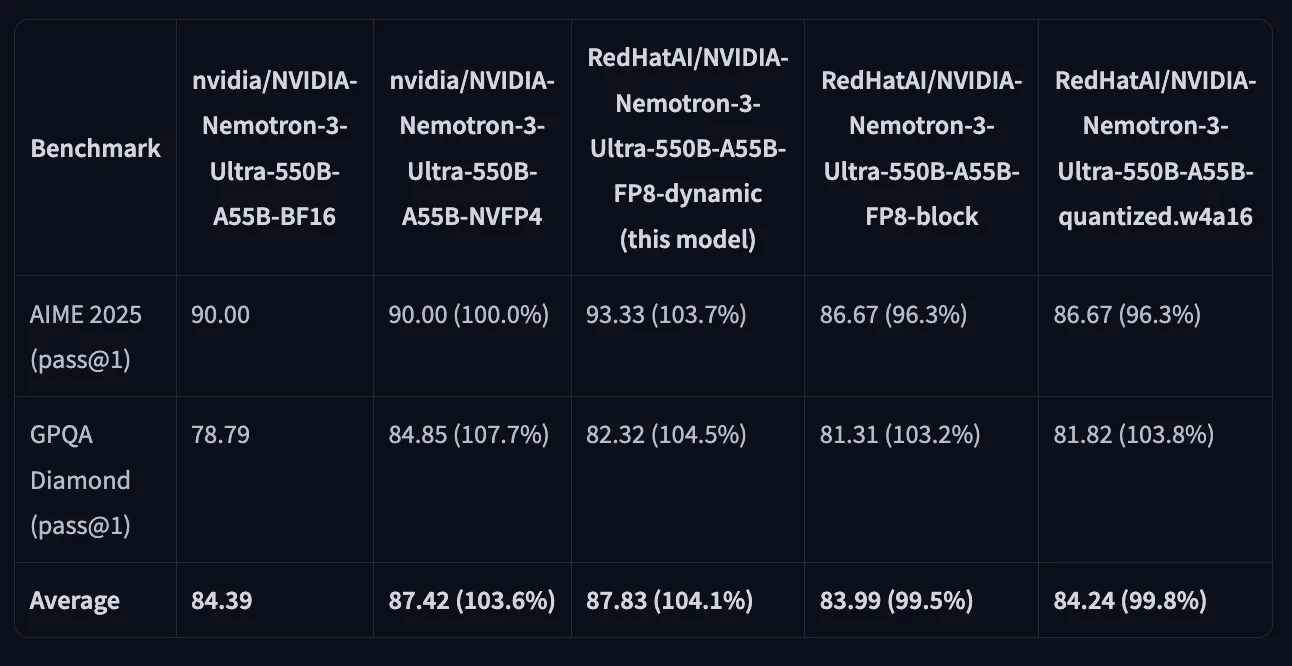
On the Hugging Face Hub, RedHatAI publishes pre-quantized variants:
RedHatAI/NVIDIA-Nemotron-3-Ultra-550B-A55B-FP8-dynamicRedHatAI/NVIDIA-Nemotron-3-Ultra-550B-A55B-quantized.w4a16
The FP8-dynamic checkpoint changed the game. vLLM loads weights that are already FP8 (auto-detected — you don’t even pass --quantization). That fixes every Phase 1 pain point:
Smaller download (~525 GB vs ~1.1 TB)
No load-time quantization spike — weights land in HBM already FP8
Faster cold starts
H200-native FP8 tensor cores do the math directly — Hopper’s fast path
Near-BF16 quality, via dynamic per-token activation scaling
And the parsers are quantization-independent: qwen3_coder + nemotron_v3 are unchanged, because quantization touches weights, not the chat template.
The zero-downtime trick: pre-warm the weights with a 0-GPU Job
The old pod holds all 8 GPUs on our only GPU node. If a new 8-GPU deployment starts before the old one dies, it sits Pending forever — and then suffers a slow 525 GB cold download. So we pull the weights ahead of time, in parallel, with a Job that requests zero GPUs. It schedules anywhere, touches no GPU, and just downloads into the new PVC while production keeps serving.
Phase 2a manifest — 0-GPU pre-warm Job (complete)
apiVersion: v1
kind: PersistentVolumeClaim
metadata:
  name: nemotron-550b-fp8-cache
  namespace: vllm
spec:
  accessModes: ["ReadWriteMany"]
  storageClassName: nfs-csi
  resources:
    requests:
      storage: 1200Gi

apiVersion: batch/v1
kind: Job
metadata:
  name: nemotron-550b-fp8-prewarm
  namespace: vllm
spec:
  backoffLimit: 4
  template:
    spec:
      restartPolicy: OnFailure
      # No GPU requested -> schedules off the GPU node; the PVC is RWX/NFS so the
      # GPU node can read these weights later. This pod only downloads.
      containers:
        - name: weight-puller
          image: vllm/vllm-openai:v0.22.0
          command: ["/bin/sh", "-c"]
          args:
            - >-
              set -eu;
              pip install -q hf_transfer 2>/dev/null || true;
              export HF_HUB_ENABLE_HF_TRANSFER=1;
              echo "Downloading ${MODEL_ID} into ${HF_HOME} ...";
              huggingface-cli download "${MODEL_ID}" --repo-type model;
              echo "DOWNLOAD COMPLETE: ${MODEL_ID}";
          env:
            - name: HF_HOME
              value: /data
            - name: MODEL_ID
              value: "RedHatAI/NVIDIA-Nemotron-3-Ultra-550B-A55B-FP8-dynamic"
            - name: HF_TOKEN
              valueFrom:
                secretKeyRef:
                  name: hf-token
                  key: token
          resources:
            requests:
              cpu: "16"
              memory: 32Gi
          volumeMounts:
            - name: cache
              mountPath: /data
      volumes:
        - name: cache
          persistentVolumeClaim:
            claimName: nemotron-550b-fp8-cache
When the Job logs DOWNLOAD COMPLETE, the weights are warm on the PVC.
Phase 2b manifest — promote to serving, then sunset the old one (complete)
⚠️ Sequencing: both deployments pin the same node and want 8 GPUs. Delete/scale the old deployment first to free the GPUs, then apply this. The warm PVC means it starts fast.
apiVersion: apps/v1
kind: Deployment
metadata:
  name: nemotron-550b-fp8
  namespace: vllm
spec:
  replicas: 1
  strategy:
    type: Recreate
  selector:
    matchLabels:
      app: nemotron-550b
  template:
    metadata:
      labels:
        app: nemotron-550b              # same label -> reuses the existing Service
    spec:
      affinity:
        nodeAffinity:
          requiredDuringSchedulingIgnoredDuringExecution:
            nodeSelectorTerms:
              - matchExpressions:
                  - key: kubernetes.io/hostname
                    operator: In
                    values: ["ihc-gpu-compute-05"]
      containers:
        - name: vllm
          image: vllm/vllm-openai:v0.22.0
          command: ["vllm", "serve", "RedHatAI/NVIDIA-Nemotron-3-Ultra-550B-A55B-FP8-dynamic"]
          args:
            - "--served-model-name"
            - "nvidia/NVIDIA-Nemotron-3-Ultra"   # keep old name -> transparent cutover
            - "--trust-remote-code"
            - "--tensor-parallel-size"
            - "8"
            - "--kv-cache-dtype"
            - "fp8"                               # FP8 KV cache -> more headroom
            - "--max-model-len"
            - "262144"
            - "--max-num-seqs"
            - "16"
            - "--max-num-batched-tokens"
            - "32768"                             # back to recipe value; we have room now
            - "--gpu-memory-utilization"
            - "0.90"
            - "--enable-chunked-prefill"
            - "--no-enable-prefix-caching"
            - "--enable-flashinfer-autotune"
            - "--async-scheduling"
            - "--mamba-backend"
            - "triton"
            - "--mamba-ssm-cache-dtype"
            - "float32"
            - "--reasoning-parser"
            - "nemotron_v3"
            - "--enable-auto-tool-choice"
            - "--tool-call-parser"
            - "qwen3_coder"
            - "--speculative_config.method"
            - "mtp"
            - "--speculative_config.num_speculative_tokens"
            - "5"
          # NOTE vs Phase 1: no --quantization (auto-detected), no --dtype, and the
          # flashinfer/float16 Mamba survival-hacks are gone — the FP8 checkpoint
          # freed enough memory that we don't need them.
          ports:
            - containerPort: 8000
          env:
            - name: HF_HOME
              value: /data
            - name: HF_TOKEN
              valueFrom:
                secretKeyRef:
                  name: hf-token
                  key: token
          resources:
            limits:
              nvidia.com/gpu: 8
            requests:
              cpu: "64"
              memory: 512Gi
              nvidia.com/gpu: 8
          volumeMounts:
            - name: cache
              mountPath: /data
            - name: shm
              mountPath: /dev/shm
          startupProbe:
            httpGet: { path: /health, port: 8000 }
            initialDelaySeconds: 60
            periodSeconds: 30
            failureThreshold: 60            # warm PVC -> much faster than Phase 1
          readinessProbe:
            httpGet: { path: /health, port: 8000 }
            periodSeconds: 10
          livenessProbe:
            httpGet: { path: /health, port: 8000 }
            periodSeconds: 30
            timeoutSeconds: 10
            failureThreshold: 6
      volumes:
        - name: cache
          persistentVolumeClaim:
            claimName: nemotron-550b-fp8-cache
        - name: shm
          emptyDir:
            medium: Memory
            sizeLimit: 16Gi
Phase 3 (planned): FP4 weights to run on 4× H200
Phase 2 is clean, but we want to free up GPUs — run on 4× H200 and use the other four elsewhere. That means 4-bit weights:
RedHatAI/...quantized.w4a16— INT4 weight-onlynvidia/NVIDIA-Nemotron-3-Ultra-550B-A55B-NVFP4— NVIDIA’s FP4 format
The math is compelling: 4-bit weights are ~280 GB, which fits on 4× H200 (~561 GiB total, ~505 GiB usable at 0.9), leaving ~225 GiB for caches. FP8 (~525 GB) can’t fit on 4 cards; FP4 can.
The catch: NVFP4 is not hardware-accelerated on H200
NVFP4’s native tensor-core acceleration requires Blackwell (B200 / GB200). Our H200s are Hopper — native FP8, but no native FP4 math units. So on H200, NVFP4 (or w4a16) runs via dequantization kernels: the 4-bit weights are unpacked to higher precision for the matmul. You get the memory savings (the whole reason to drop to 4 GPUs) but not the FP4 compute speedup Blackwell would give you. In compute-bound regimes, FP4-on-Hopper can even be slower than FP8-on-Hopper, because FP8 hits the silicon directly while FP4 pays a dequant tax.
So Phase 3 is a deliberate trade: fit on 4 GPUs (FP4, no native accel) vs. peak throughput on 8 GPUs (FP8, native Hopper accel).
Phase 3 manifest (complete)
apiVersion: v1
kind: PersistentVolumeClaim
metadata:
  name: nemotron-550b-fp4-cache
  namespace: vllm
spec:
  accessModes: ["ReadWriteMany"]
  storageClassName: nfs-csi
  resources:
    requests:
      storage: 600Gi                  # ~280 GB of 4-bit weights

apiVersion: apps/v1
kind: Deployment
metadata:
  name: nemotron-550b-fp4
  namespace: vllm
spec:
  replicas: 1
  strategy:
    type: Recreate
  selector:
    matchLabels:
      app: nemotron-550b-fp4
  template:
    metadata:
      labels:
        app: nemotron-550b-fp4
    spec:
      affinity:
        nodeAffinity:
          requiredDuringSchedulingIgnoredDuringExecution:
            nodeSelectorTerms:
              - matchExpressions:
                  - key: kubernetes.io/hostname
                    operator: In
                    values: ["ihc-gpu-compute-05"]
      containers:
        - name: vllm
          image: vllm/vllm-openai:v0.22.0
          command: ["vllm", "serve", "RedHatAI/NVIDIA-Nemotron-3-Ultra-550B-A55B-quantized.w4a16"]
          args:
            - "--served-model-name"
            - "nvidia/NVIDIA-Nemotron-3-Ultra"
            - "--trust-remote-code"
            - "--tensor-parallel-size"
            - "4"                         # half the node now
            - "--kv-cache-dtype"
            - "fp8"
            - "--max-model-len"
            - "262144"
            - "--max-num-seqs"
            - "16"
            - "--gpu-memory-utilization"
            - "0.90"
            - "--enable-chunked-prefill"
            - "--no-enable-prefix-caching"
            - "--mamba-backend"
            - "triton"
            - "--reasoning-parser"
            - "nemotron_v3"
            - "--enable-auto-tool-choice"
            - "--tool-call-parser"
            - "qwen3_coder"
            - "--speculative_config.method"
            - "mtp"
            - "--speculative_config.num_speculative_tokens"
            - "5"
          ports:
            - containerPort: 8000
          env:
            - name: HF_HOME
              value: /data
            - name: HF_TOKEN
              valueFrom:
                secretKeyRef:
                  name: hf-token
                  key: token
          resources:
            limits:
              nvidia.com/gpu: 4
            requests:
              cpu: "48"
              memory: 256Gi
              nvidia.com/gpu: 4
          volumeMounts:
            - name: cache
              mountPath: /data
            - name: shm
              mountPath: /dev/shm
          startupProbe:
            httpGet: { path: /health, port: 8000 }
            initialDelaySeconds: 60
            periodSeconds: 30
            failureThreshold: 60
          readinessProbe:
            httpGet: { path: /health, port: 8000 }
            periodSeconds: 10
          livenessProbe:
            httpGet: { path: /health, port: 8000 }
            periodSeconds: 30
            timeoutSeconds: 10
            failureThreshold: 6
      volumes:
        - name: cache
          persistentVolumeClaim:
            claimName: nemotron-550b-fp4-cache
        - name: shm
          emptyDir:
            medium: Memory
            sizeLimit: 16Gi
(Use the same 0-GPU pre-warm Job from Phase 2 — just point MODEL_ID at the w4a16 or NVFP4 repo and a fresh PVC.)
Lessons learned
Architecture drives the memory story. MoE keeps all 550B weights in HBM (it saves compute, not memory), so weight quantization is the master lever. The Mamba layers keep per-sequence state tiny; the few attention layers still need a KV cache you can shrink with FP8.
Runtime quantization is a survival hack, not a strategy. It fits the model, but you pay in download size, a load-time spike, and slow cold starts. Pre-quantized checkpoints are strictly better when they exist.
Match the quantization to the silicon. H200 = Hopper = native FP8. FP4 buys you memory (fewer GPUs), not speed on Hopper — native FP4 is a Blackwell feature.
Quantization is orthogonal to parsers. Tool-calling and reasoning parsers key off the chat template, not the weights.
Pre-warm with a 0-GPU Job. Downloading into a PVC while the old model keeps serving turns a terabyte-scale migration into a near-zero-downtime cutover.
PhaseWeightsGPUsFootprintNotes:
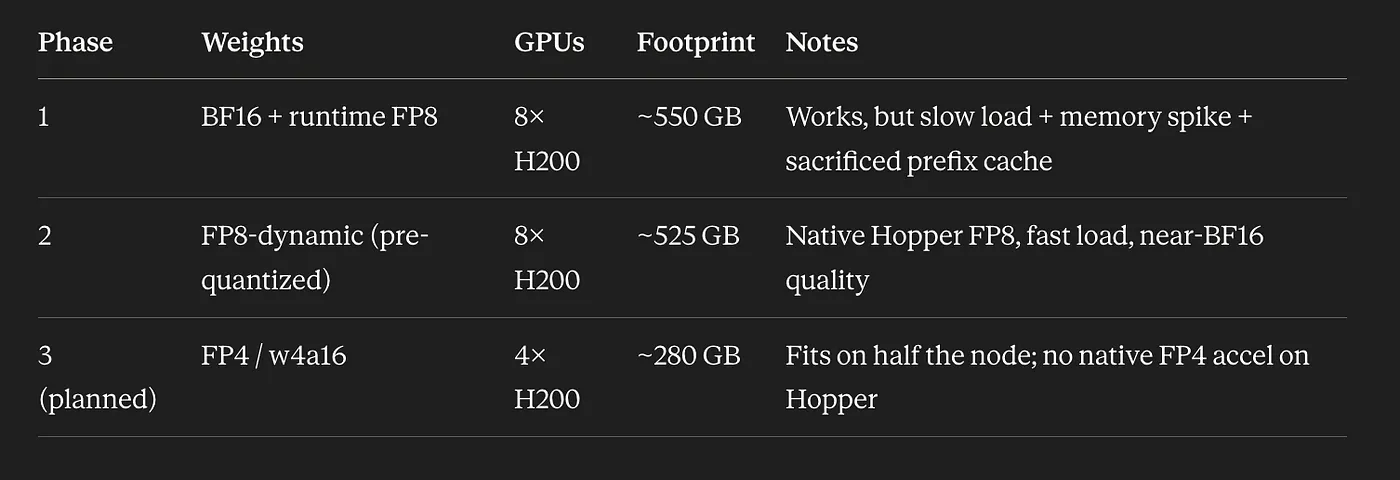
From “this needs two nodes” to “this runs on half of one” — that’s the power of picking the right quantization for your hardware.
Running large hybrid MoE models on constrained GPU fleets? The checkpoint format is as much an infrastructure decision as a model decision.